
Berba: Goddess of the Barrow
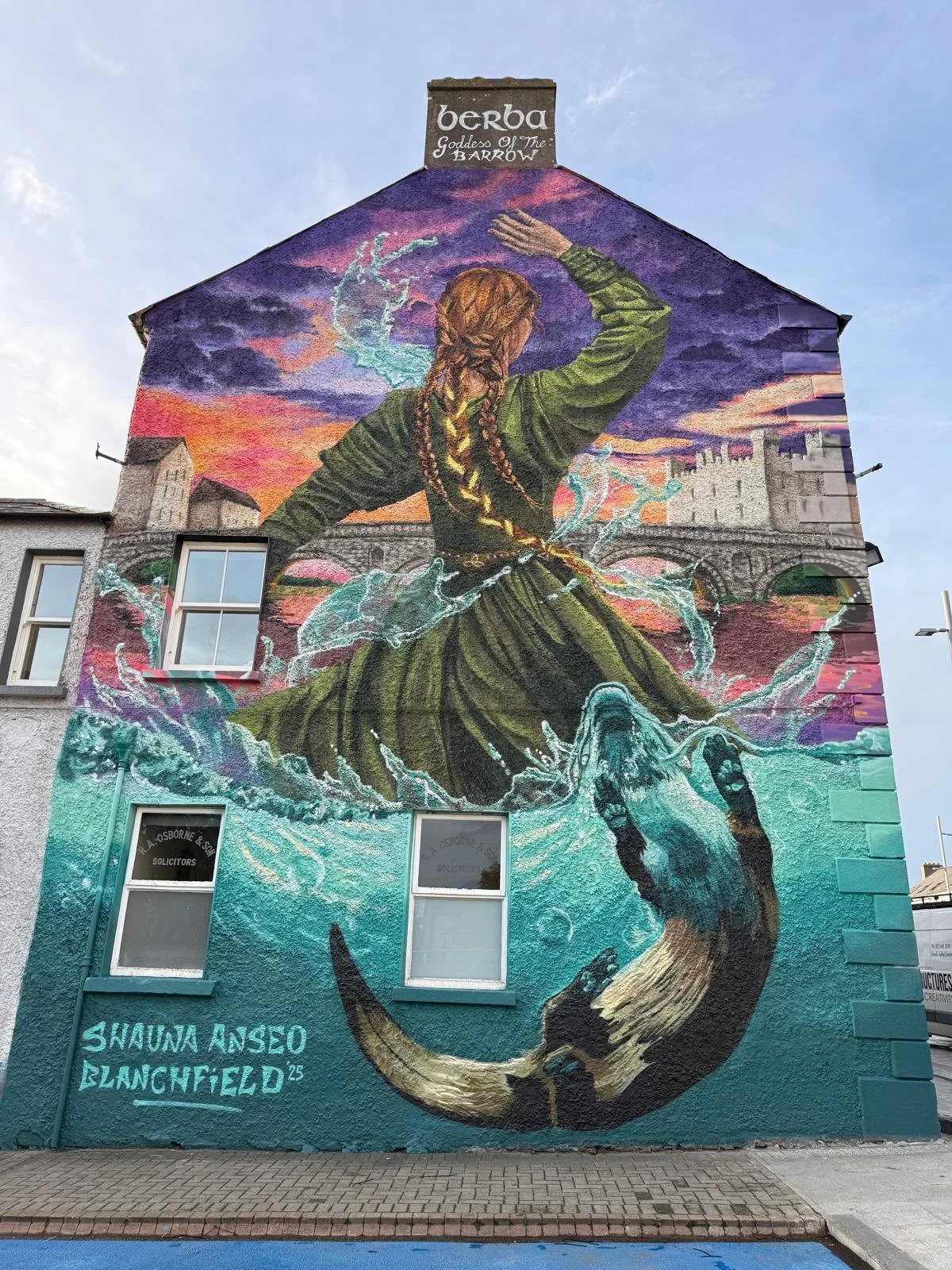
Berba: Goddess of the River
Location: Athy, County Kildare, Ireland
Client: Kildare County Council
Funding: Failte Ireland & the EU Just Transition Fund
Site type: Public square regeneration / civic landmark
Role: Lead artist
Year: 2025
Outcome: A landmark mural marking Athy’s moment of transformation, honouring the town’s river heritage while looking confidently toward its future.
Developer Takeaway: Aligning regeneration with local myth created a symbolic marker for change, reinforcing continuity and identity during a town-centre transformation.
The Context
Athy is a historic Irish market town situated at a key crossing point of the River Barrow. For centuries, its prosperity was shaped by waterways: the river and canal networks that connected Athy to Dublin and supported trade, movement, and exchange.
Following the economic crash, the town experienced a prolonged period of neglect. More recently, central government funding enabled a programme of regeneration across Athy, including the restoration of Emily Square, returned from a car park to a public square, and the reopening of the Ernest Shackleton Museum, which sits directly on the square.
The murals were commissioned to mark this moment: a visible signal of renewal that respected Athy’s deep history while articulating a renewed civic confidence.
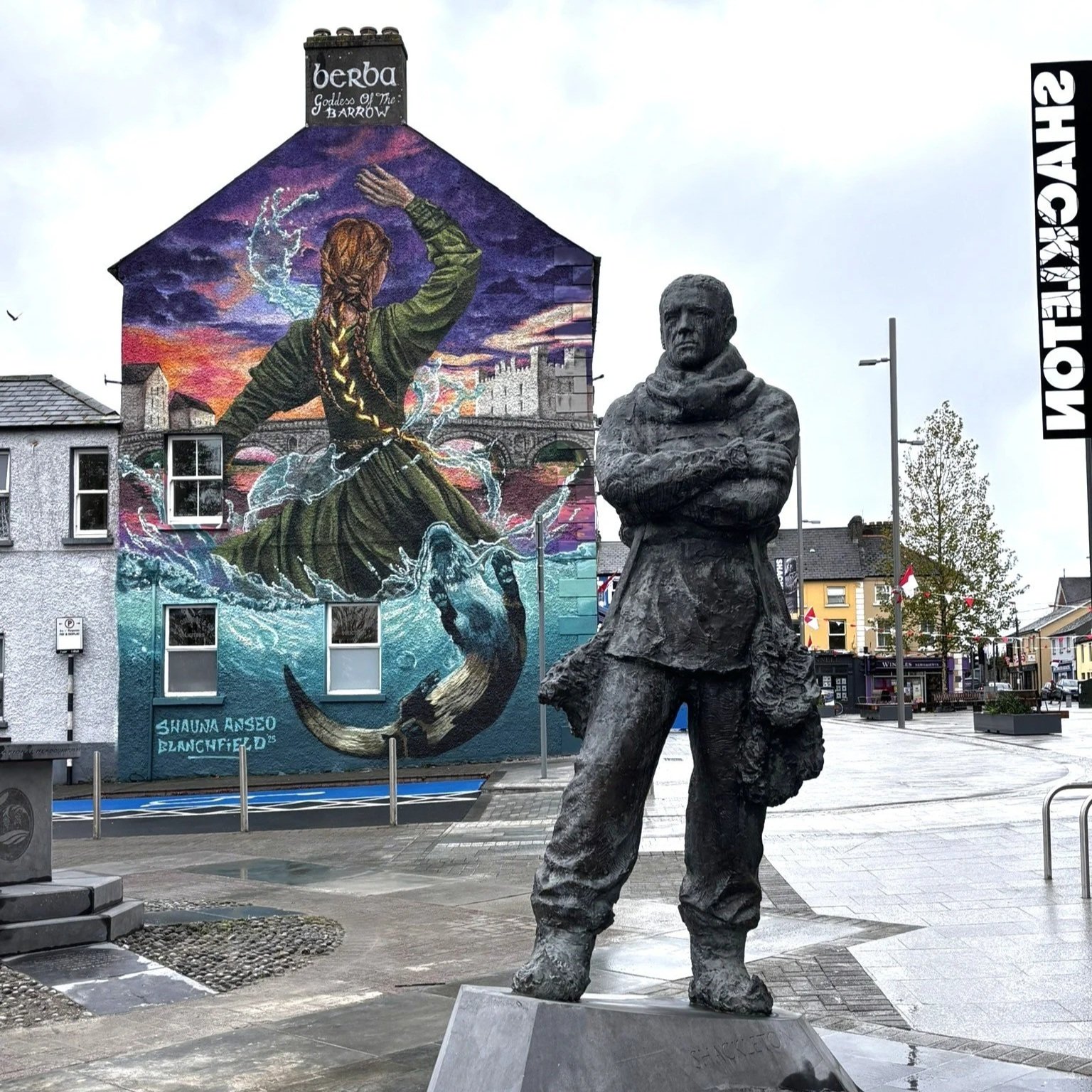
Berba: Goddess of the River in situ behind a statue of Ernest Shackleton. Outside the Ernest Shackleton Museum, on Emily Square, Athy.
The Challenge
Conceptual challenge:
The brief called for an artwork celebrating the River Barrow. However, there were already murals in the town depicting river wildlife and landscape. Repeating that visual language risked producing something generic, pleasant, but unable to function as a shared symbol.
The challenge was to create an artwork that could act as a civic marker: something people would gather around, identify with, and recognise as representing this moment in Athy’s story.
Time constraints:
The project was confirmed late, with approximately two months from briefing to completion. The mural needed to be delivered in time for the reopening of the square and museum, with no flexibility in the deadline.
Technical constraints:
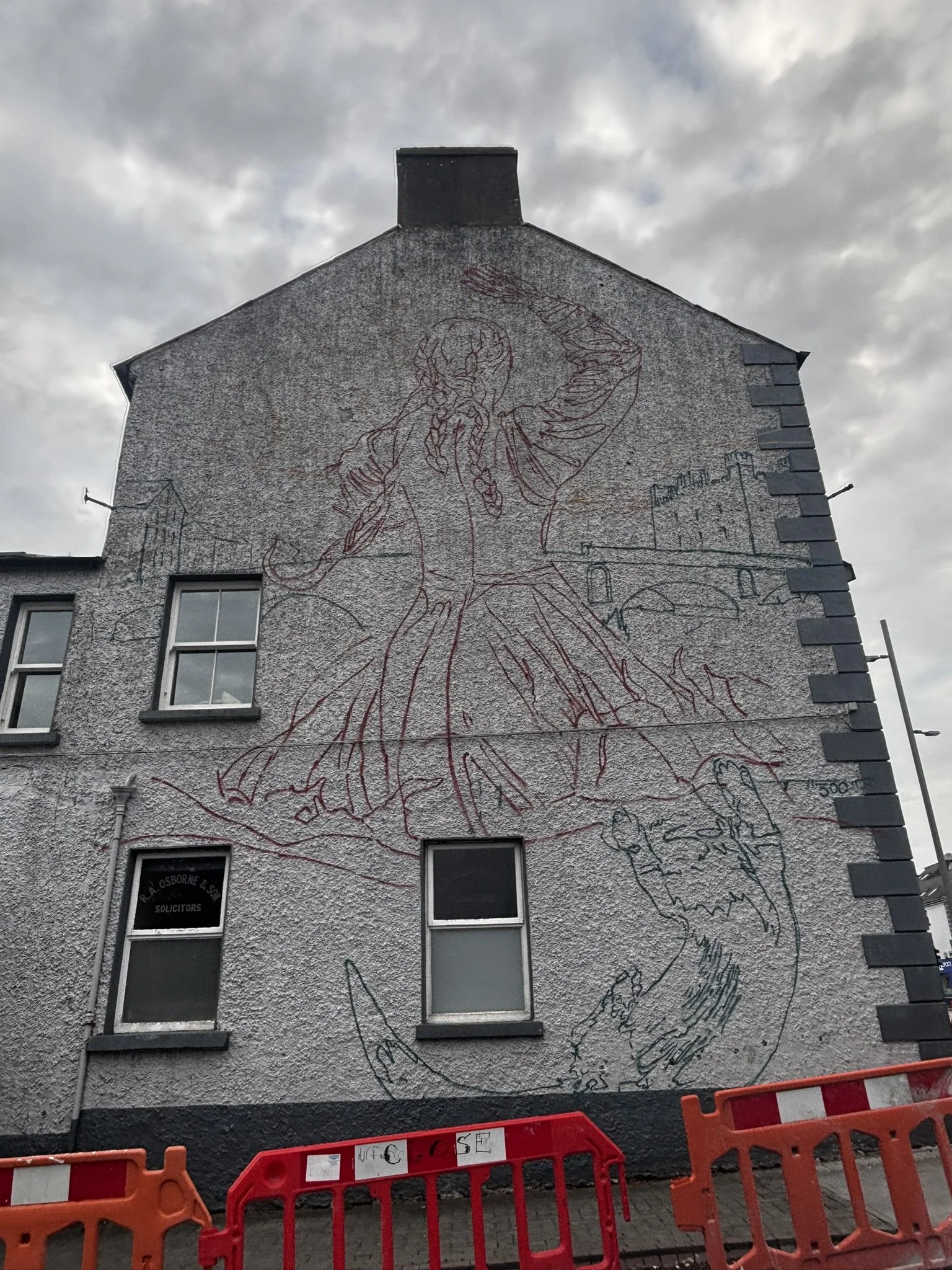
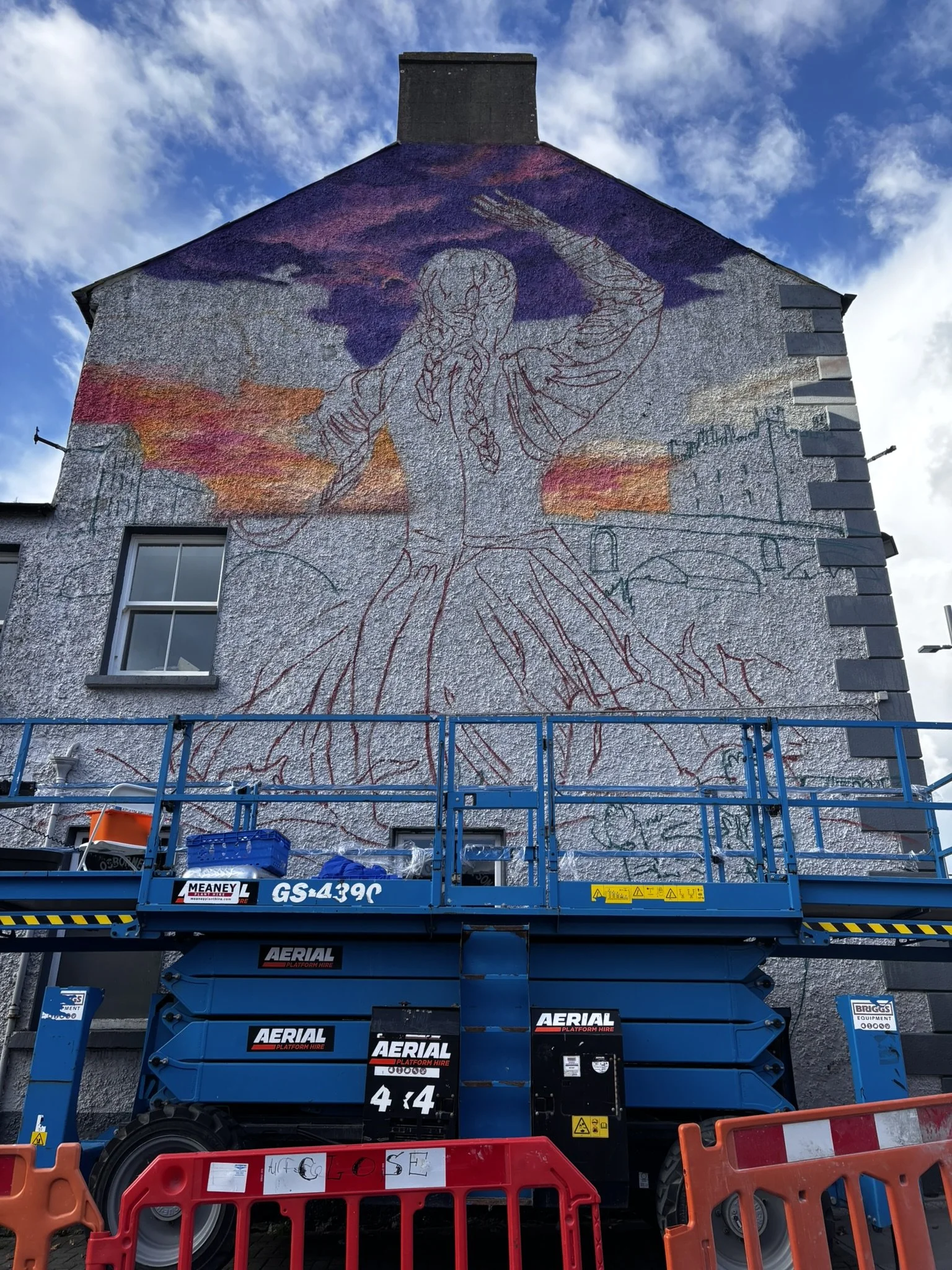
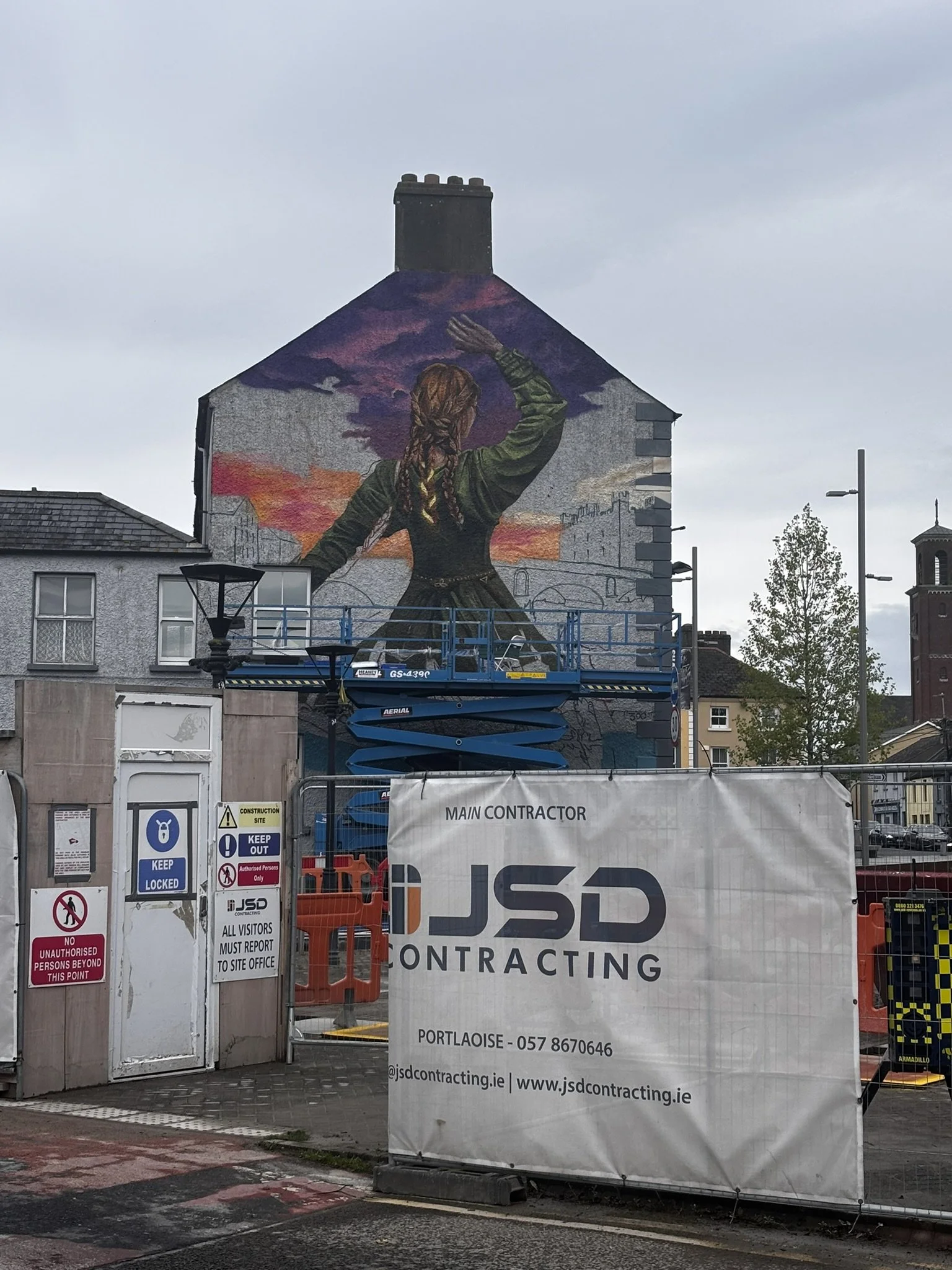
The wall was a three-storey gable end finished in pebbledash, a difficult and unforgiving surface. This required stabilisation before painting and influenced both the technique and complexity of the final image. The site conditions and uneven ground necessitated the use of a wide scissor lift with stabilisers, and the entire mural had to be completed in just eight days.
The Approach
With limited time for formal workshops, the research phase focused on local history, folklore, and symbolism. Conversations with historians and folklorists revealed the story of Berba, the goddess of the River Barrow in Irish mythology.
Berba is one of the three sister river goddesses, the Barrow, Noir, and Suir, and the largest river and principal sister among them. In the original legend, she escapes down the river from a hunter in the form of an otter before revealing herself as a goddess in a moment of transformation.
The symbolism was immediately resonant. The river remains constant while the town changes; it carries memory, witnesses generations, and endures beyond individual moments of rise and decline. Berba’s transformation became a powerful metaphor for Athy itself, a town changing form while remaining rooted in its origins.
Although formal community engagement was limited by time, the designs were tested through informal local feedback, including family and community connections in the area. This ensured the imagery aligned with local sensibilities while allowing decisive progress.
The Artwork
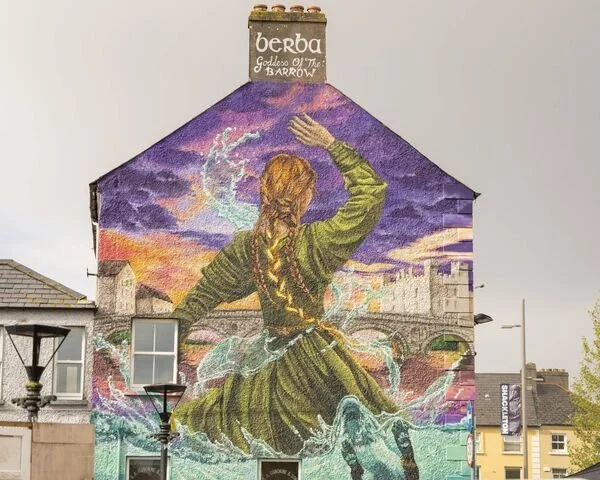
The final mural is a three-storey gable-end work positioned on the edge of Emily Square, directly facing the Ernest Shackleton Museum.
Berba is depicted emerging from the River Barrow in a swirling moment of transformation, part otter, part goddess. Her raised hand gestures toward the future, while her braided hair contains three strands representing the sister rivers, with Berba’s golden strand flowing connecting the figure to the water.
The composition holds past and future simultaneously:
the historic bridge Crom a Boo bridge
White’s Castle on the East Bank, built in the 16th century and still central to the town’s identity
trading warehouses on the West Bank that no longer exist but we’re once key to the river as a trading post
She faces a setting sun, a symbol of renewal rather than ending, reinforcing the sense of transition and continuity.
Scale: Three storeys
Surface: Pebbledash (stabilised prior to painting)
Medium: Spray paint
Finish: Unvarnished, to avoid light distortion on textured surface
Access: Wide scissor lift with stabilisers
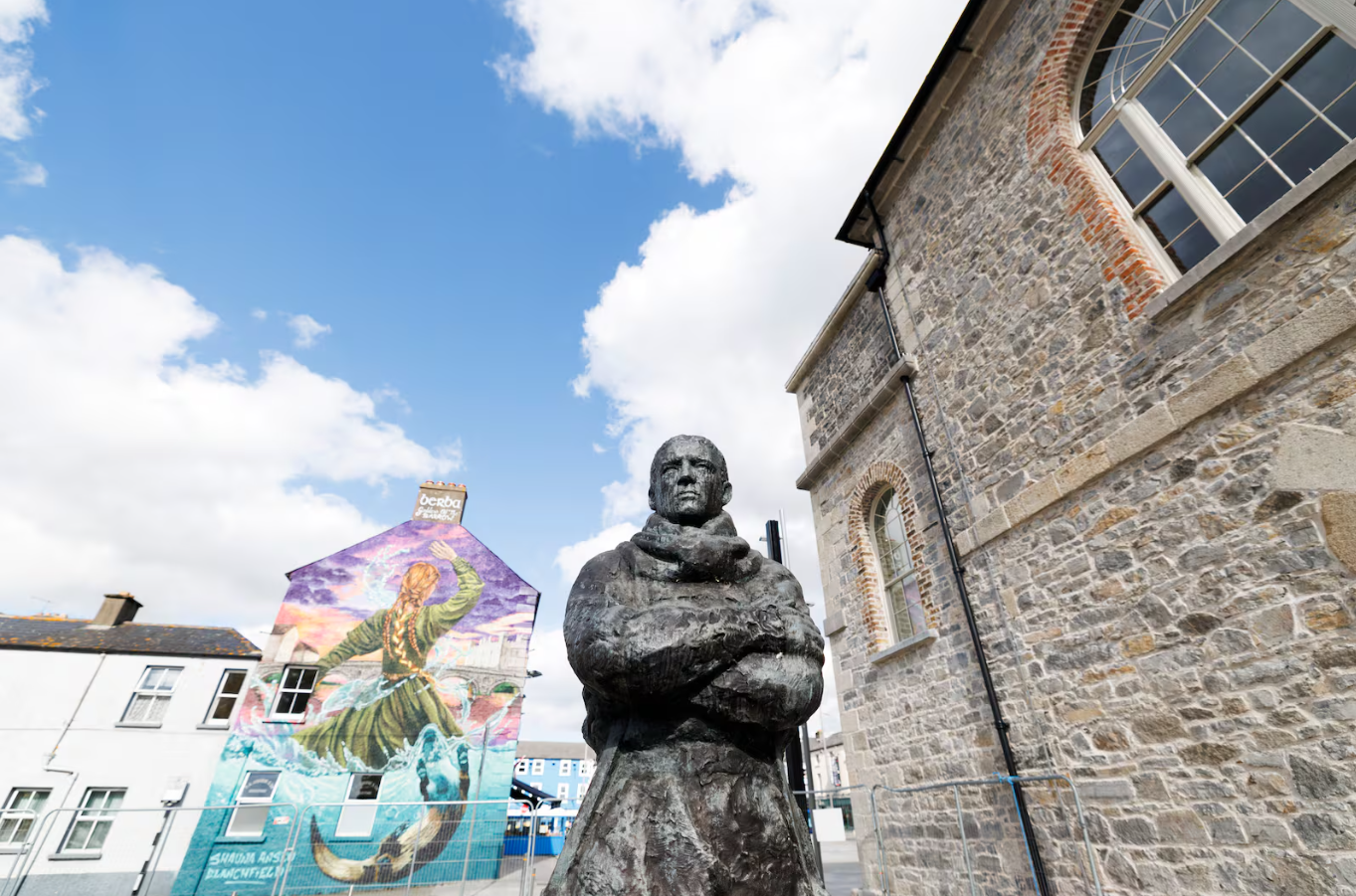
Mural in situ from Irish Times Photo Essay, Photo © Dan Dennison
The Outcome
Before the mural, few people in Athy were familiar with the story of Berba. She was often confused with the more well known figure of Brigid from Irish mythology. The artwork introduced a new-old symbol, one that felt authentic without being overfamiliar.
The mural has since become:
a point of identification and pride
a wayfinding marker within the regenerated square
a companion landmark to the Shackleton Museum
It is frequently photographed, used in town promotion, and engaged with physically, particularly by young people. Local residents have been seen mimicking Berba’s twisting raised arm gesture for social media, interpreting it as a sign of possibility and forward movement.
Feedback from heritage groups, museum staff, and local historians has been overwhelmingly positive, recognising the mural as a respectful and imaginative reintroduction of mythology into contemporary civic space.
Why It Worked
This project succeeded because the symbolism was precisely aligned with the moment.
Berba’s transformation mirrored Athy’s own, a town renewing itself while remaining anchored to its river, its crossings, and its history. The artwork neither ignored the past nor became trapped by it; instead, it positioned Athy within a longer continuum of change.
Strong trust from the council allowed the artist space to respond intuitively, making decisions on site as the image evolved. At the same time, key local symbols, the bridge, the castle, the river, ensured the mural reflected how residents already understood their town.
By introducing myth as a lens rather than nostalgia as an endpoint, the mural invites Athy to see itself as part of something older, broader, and still unfolding.
“This project is a perfect example of how targeted investment in public spaces can revitalise our towns, support local businesses and create new opportunities for tourism and community engagement. The restoration of heritage features and the addition of public art will ensure Emily Square remains a focal point for Athy for generations to come.”
Press and Coverage
17 Sep 2025: Kildare Nationalist | Emily Square reopens in Athy after €2.7m refurb
Discuss your site, objectives, and whether a story-led approach is right for your space.